How long does it take to do a pull-up?
From zero, a first pull-up takes beginners anywhere from 2 to 12 months of training two to four times a week. Where you start matters most: someone who can hang for 30 seconds and do a few push-ups is months ahead of someone who can’t hang yet. In one 12-week study, 4 of 17 untrained women got there.
By Aleksandr Chichkanov, maker of Overbar · Updated October 27, 2026
How long, by where you start
The table is Overbar’s forecast, the one the app and the first pull-up calculator use, for three 15-minute sessions a week, age 29, with a pull-up bar. The first number is the middle estimate; the range is a slower and a faster pace.
| Where you start | Women | Men |
|---|---|---|
| Can’t hang 10 seconds, no push-ups | about 33 weeks (20–53) | about 26 weeks (16–49) |
| Hang 10–29 seconds, 1–5 push-ups | about 27 weeks (16–51) | about 20 weeks (12–39) |
| Hang 30–60 seconds, 6–15 push-ups | about 22 weeks (14–43) | about 16 weeks (10–31) |
| Can lower yourself slowly from the top | about 12 weeks (8–22) | about 9 weeks (6–16) |
Why do the columns differ? On average, men start with more upper-body strength relative to body weight, so their estimate starts further along. The pace is the same: women gain relative upper-body strength at least as fast as men (Roberts 2020). The forecast changes only where you start, never how fast you improve.
What the research says
There’s no large study of how long a first pull-up takes; the best-known one is small, and useful. In a 12-week program for college women who couldn’t do a pull-up, training three times a week, 4 of 17 did one by the end, and their strength rose about 36% (Flanagan 2003). So 12 weeks is enough for some people who start close, and not for most who start far away. That’s why honest timelines are in months, and why they need a range.
What makes it faster?
Training more often, keeping sessions short, and doing the right moves. Each of these moves the estimate:
- More days. More sessions a week build more strength through more total work (Grgic 2018). In the 27-week example, two days instead of three makes it about 33 weeks; four days of 20 minutes makes it about 21.
- Short sessions are fine. Four 15-minute sessions a week matched two 60-minute ones, pull-ups included (Kilen 2020).
- Slow lowers. Lowering builds more strength than lifting the same load (Roig 2009), and small daily doses beat one big weekly one in an arm study (Yoshida 2022).
- Help that comes off in small steps. Bands or an assisted machine take a few weeks off (about 25 and 23 weeks in the example).
- Stopping sets early. Grinding to failure didn’t build more in a pull-up study of trained men (Sánchez-Moreno 2020).
What makes it slower?
Fewer sessions, joint pain and age. The forecast assumes a slightly slower pace from 30, slower from 45 and slower again from 60, and a gentler plan with joint pain. Age doesn’t stop you: adults over 50 gained about a quarter more pulling strength with regular resistance training (Peterson 2010). Pain is different: sharp or joint pain during a set means stop, and pain that lasts more than a week means seeing a professional.
Can you get a pull-up in 30 days?
Rarely. If you can already lower yourself slowly from the top, Overbar’s forecast puts a first pull-up about two to three months away. From never having done one, its fastest start (a man with a one-minute hang and 16 or more push-ups, training four 30-minute sessions a week at a gym) is about 10 weeks, 6 at the fast end of its range, and typical starts are four to eight months. A 30-day challenge is a fine way to build the habit; just don’t judge yourself by day 30.
How do you know you’re close?
When you can lower yourself from the top for about 10 seconds and hold your chin over the bar for 30. That’s the goal that ends Overbar’s Almost There stage, and the point where fresh tries at a full pull-up start to land. Before that, the milestones are a 30-second hang, then a 15-second top hold, then a 5-second slow lower.
Why we show a range, not a date
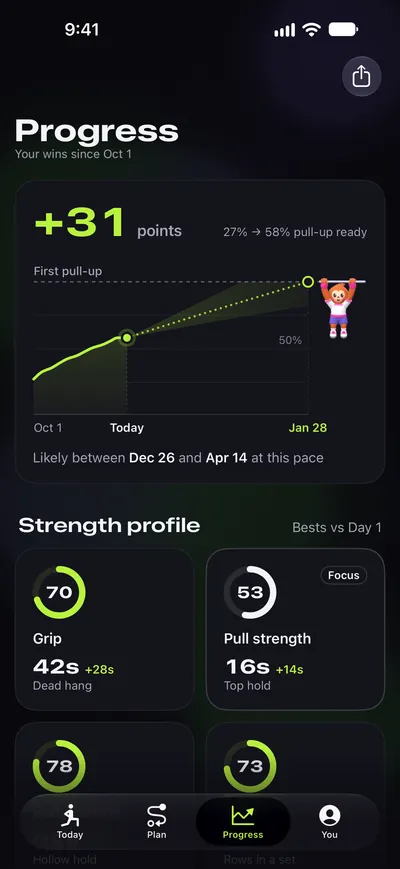
Because people improve at different speeds, and nobody can see yours in advance. The range is the same forecast at a slower and a faster pace. In the app, Day 1 measures where you really are, every check-in measures you again, and after three check-ins the date follows your own pace. It’s an estimate, never a promise; past a year, the app talks in milestones instead of dates.
How it’s worked out, factor by factor: How Overbar works out your date.
Questions
How long does it take to do a pull-up from scratch?
For beginners, anywhere from 2 to 12 months of training two to four times a week. If you can’t hang for 10 seconds yet, plan on the longer end; if you can hang for 30 seconds and do some push-ups, the shorter.
How long does it take a woman to do her first pull-up?
In Overbar’s forecast, about 22 to 33 weeks for typical starts at three short sessions a week, and about 12 if you can already lower yourself slowly. Women build relative upper-body strength at least as fast as men; they usually start further back.
Can I do a pull-up in a week?
Only if you’re one good session away already. Strength takes weeks to build. A week is enough to learn the moves, time your hang and start the habit.
How many days a week should I train for a pull-up?
Two to four. Three days of 15 minutes is a good start; with four, don’t put your hardest bar work (the slow lowers) on two days in a row.
Do I lose progress if I miss a week?
Very little. After a few days off, carry on; after one to four weeks, repeat your last week; after a month away, test your hang, holds and lowers again before you carry on.
How can I get my own estimate?
Answer the questions in the first pull-up calculator. It runs the same forecast as the Overbar app and shows your estimate, its range and the stage you’d start in.
Watch your date come closer.
Overbar measures you on Day 1 and moves your estimate after every workout, so you always know how close you are. Day 1 and Quick Hangs are free; Pro is $49.99 a year with a free week, or $5.99 a week.
Download on the App Store